Is it Time to Stop Encouraging Cyclists to Wear Helmets?
— By Kevin Montgomery (@kevinmonty) |
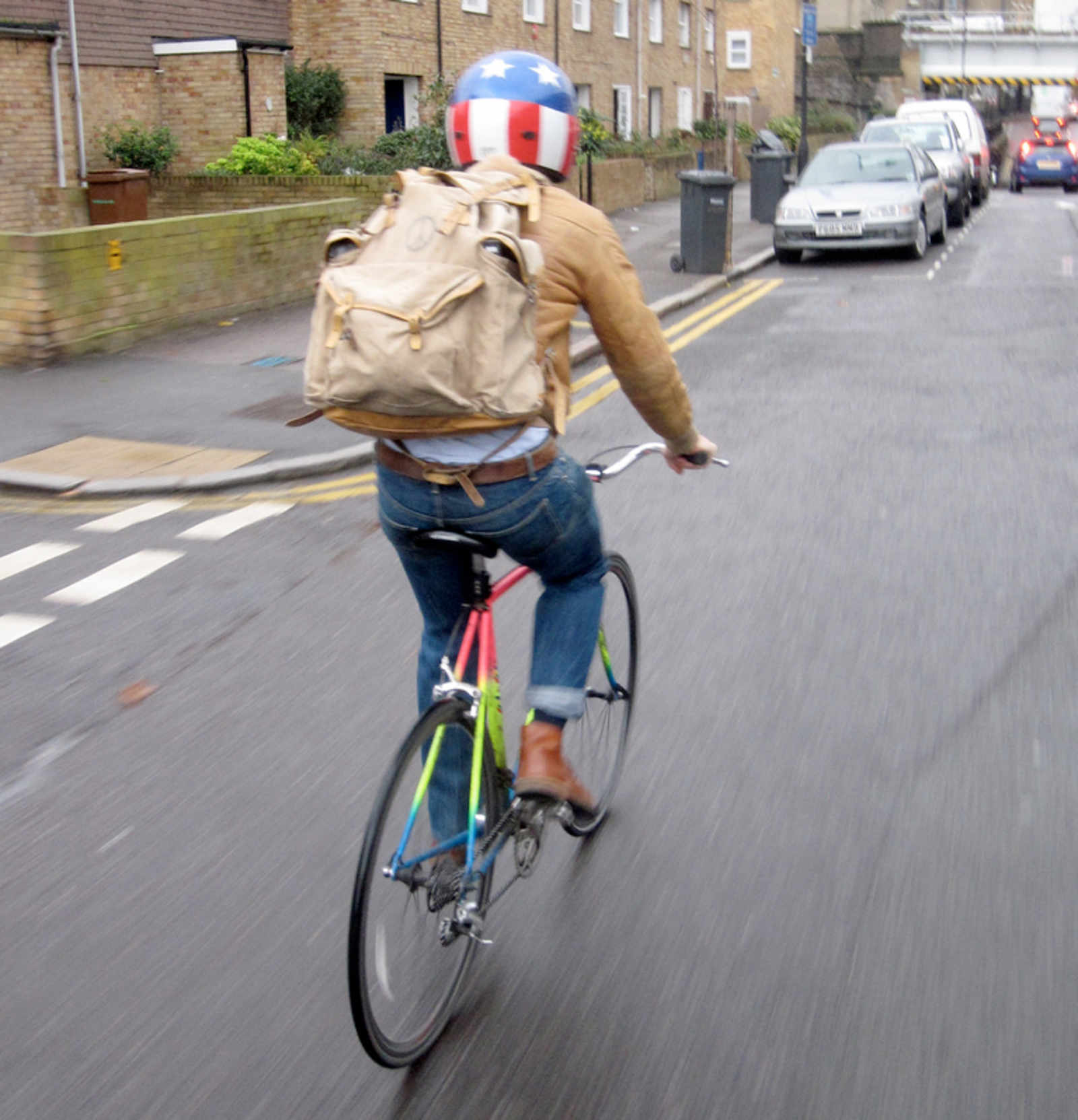
I don't wear a helmet in San Francisco. It's part laziness (carrying it around is annoying and locking it up will most certainly get it stolen) and part vanity (helmets make me sweaty and gross, and helmet hair is awful and my sex life is such that I cannot afford anymore handicaps), but it's in no part stupidity.
I wear helmets when it counts: mountain biking, when I'm plenty apt to crash into a tree or eat dirt due to general imbalance and ineptitude, or while heading out for a long road ride in Marin, when loose gravel, high speeds, and crazed BMW motorists have a knack for creating unsafe situations (also, I don't care how my beautifully-sculpted hair looks after any of these activities). But in SF while getting back and forth from work? Nope. Between lower speeds on both mine and the drivers part, coupled with straighter roads, bike lanes, and the sheer number of bikes on the street increasing our visibility, the risk factor just isn't there.
That's not to say I don't hear about my choice. The city's metermaids that are required to wear exceptionally dorky bike helmets while riding around in their fun lil' Cushmans are particularly vocal, smugly telling this non-revenue generating rider that “I should be wearing a helmet.” The San Francisco Bike Coalition is similarly in rider's faces, demanding that members bring helmets to the organization's events. I even once dated a girl who told me she wasn't sure she could date someone who “didn't value his life” because I don't strap on a lid before riding 5 blocks to Dolores Park.
But, it turns out, that San Francisco's bike advocates might be doing themselves a genuine disservice in promoting helmet usage, as helmets actually discourage people from getting on a bike. And for a city that aims to have 20% of all commuters on a bike by 2020, despite only 3.5% do so today, we could use all the help we get.
In the United States the notion that bike helmets promote health and safety by preventing head injuries is taken as pretty near God’s truth. Un-helmeted cyclists are regarded as irresponsible, like people who smoke. Cities are aggressive in helmet promotion.
But many European health experts have taken a very different view: Yes, there are studies that show that if you fall off a bicycle at a certain speed and hit your head, a helmet can reduce your risk of serious head injury. But such falls off bikes are rare — exceedingly so in mature urban cycling systems.
On the other hand, many researchers say, if you force or pressure people to wear helmets, you discourage them from riding bicycles. That means more obesity, heart disease and diabetes. And — Catch-22 — a result is fewer ordinary cyclists on the road, which makes it harder to develop a safe bicycling network. The safest biking cities are places like Amsterdam and Copenhagen, where middle-aged commuters are mainstay riders and the fraction of adults in helmets is minuscule.“Pushing helmets really kills cycling and bike-sharing in particular because it promotes a sense of danger that just isn’t justified — in fact, cycling has many health benefits,” says Piet de Jong, a professor in the department of applied finance and actuarial studies at Macquarie University in Sydney. He studied the issue with mathematical modeling, and concludes that the benefits may outweigh the risks by 20 to 1.
As San Francisco moves to install its 50 station/500 bikes bike-sharing program, the issue of helmets could be the difference between its success or failure. In cities where helmets are mandatory, participation in the program is low (just 150 rides a day in Melbourne, Australia), whereas it soars in cities were it is optional (5,000 rides a day in Dublin). As a biking coordinator in Minniapolis said, “I just want it to be seen as something that a normal person can do. You don’t need special gear. You just get on a bike and you just go.”